
Sacramento FrenchFilm Festival

Connecting and Re-connecting
Connecting and Re-connecting
As we get ready for the thirteenth annual Sacramento French
Film Festival, I have been looking for relations between the films that are on
this year’s program and those from previous festivals.
Re-relating with Lucas Belvaux
The opening night movie is Lucas Belvaux’s ninth feature film Pas son genre (2013).
At
the 2002 festival we had the opportunity to see his daring trilogy (2002) On The Run, An Amazing Couple, and AfterLife. These films do not tell the same
story from different points of view but weave together three film genres – a
thriller followed by a romantic comedy and then a melodrama – together they
give us the parts, the outcomes, and consequences of the combined scenarios of
all three movies.

In 2010, the Festival brought us another tour de force courtesy of Belvaux: Rapt (2009), a powerful drama about the downfall of rich and powerful businessman derived from the real-life kidnapping of Baron Édouard-Jean Empain in 1978. Two years later 38 Witnesses (2012) came to our Festival. Once again we encounter a tough drama that is also loosely based on a true story this one from New York City in 1964. Kitty Genovese, a young New York waitress was brutally murdered on a residential street, but not one of 38 witnesses the police questioned that were in the vicinity, could remember hearing or seeing anything. Belvaux moved the action of his film to Le Havre on the Normandy coast, France’s biggest container ship port. The police investigation and the unraveling of the story take place against the backdrop of giant container ships and the massive docks with their monstrous cranes and offloading gear that tower over the city's inhabitants.
In 2010, the Festival brought us another tour de force courtesy of Belvaux: Rapt (2009), a powerful drama about the downfall of rich and powerful businessman derived from the real-life kidnapping of Baron Édouard-Jean Empain in 1978. Two years later 38 Witnesses (2012) came to our Festival. Once again we encounter a tough drama that is also loosely based on a true story this one from New York City in 1964. Kitty Genovese, a young New York waitress was brutally murdered on a residential street, but not one of 38 witnesses the police questioned that were in the vicinity, could remember hearing or seeing anything. Belvaux moved the action of his film to Le Havre on the Normandy coast, France’s biggest container ship port. The police investigation and the unraveling of the story take place against the backdrop of giant container ships and the massive docks with their monstrous cranes and offloading gear that tower over the city's inhabitants.

Pas son genre
Belvaux’s latest film differs quite a bit in tone and mood from
his 2009 and 2012 features, however that is just on the surface, since this drama also revolves around conflict. A high school philosophy
teacher from Paris – Clément Le Guern - is transferred to the “Provinces,” the town
of Arras in the Pas-de-Calais department. As he settles in to what he hopes
will be a temporary residence, he meets Jennifer, a hairdresser who has
lived there all of her life. The
story that ensues is an adaptation of a novel
by Philippe Vilain, an author who seems to study love as a multi-faceted,
multi-dimensional thing that can bring people together and tear them apart as
they grapple with the different ways each views love. The movie develops in a way that we’re both
attracted and distanced from each of the characters – Vilain’s novel was
written in the first person from the point of view of the philosophy teacher,
but Belvaux tries to draw his story from both points of view – his and hers,
the Parisian and the provincial, the philosopher and the hairdresser.

This portrait of how differences in background and culture coalesce while also complicating and impeding love is made all the more engaging by the performances of the two central characters. Emilie Dequenne plays Jennifer, bubbly and a little naive, fun-loving, at times a little on the garish side, and yet lovable and heart-breaking. Loic Cobery’s Clément is very handsome, enticing, but a little condescending and at the same time a really passionate teacher. Both of them are new to the Sacramento French Film Festival.
This portrait of how differences in background and culture coalesce while also complicating and impeding love is made all the more engaging by the performances of the two central characters. Emilie Dequenne plays Jennifer, bubbly and a little naive, fun-loving, at times a little on the garish side, and yet lovable and heart-breaking. Loic Cobery’s Clément is very handsome, enticing, but a little condescending and at the same time a really passionate teacher. Both of them are new to the Sacramento French Film Festival.

Emilie Dequenne - Like Lucas Belvaux Emilie
Dequenne was born in Belgium. In 1999, she was cast by the Dardenne brothers –
also from Belgium - to play the title role in Rosetta, a gritty story about a young woman who desperately tries
to find work and hold on to her job so that she can be a part of society and
live what she sees as a normal life. She
was awarded the palme d’or for her
interpretation of Rosetta. In 2009, she received her second award at Cannes – le prix de l’interprétation feminine in
the Un certain regard competition for
her role as a young mother who murders her five children in Joachim Lafosse’s A perdre la raison, based on a true
story.

Loïc Corbery is also a distinguished actor but most of his
work has been on the stage. He has
been a sociétaire of the Comédie Française since 2010 and has played all kinds
of classical roles from plays by Molière, Corneille, Shakespeare, Aristophanes,
and the like. Like Grégory Gadebois,
another Comédie Française actor who starred in Angèle et Tony (SFFF 2011), he brings to the screen a unique and
solid theatrical training that adds strength and depth to his performance.

Other connections
This film has lots of dimensions and angles to it taking us into the heart of French culture, introducing us to a multi-faceted and constantly changing and challenging world of life and love.
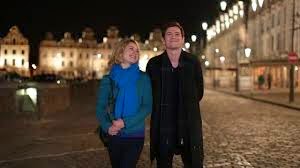
Return to Flanders - Lucas Belvaux was born in Namur in Belgium. His home-town has a lot in common with the
city of Arras, the setting for Pas son
genre. Today Namur is the capital of Wallonia (French-speaking Belgium) and
Arras is the chef-lieu of the
Pas-de-Calais department in France.

However, throughout their histories both
cities have changed hands having been variously owned by, among others, Counts of Flanders
and Dukes of Burgundy, and both cities have fine examples of Flemish
architecture. Arras, sometimes known as the most southern of the "capitales" flamandes,
has a population of around 50,000, which makes it very provincial when
compared to Paris, but Arras has a long proud history as a powerful northern
city and one of the preferred residencies of the medieval Dukes of Flanders.

Arras and Social Conflict - By setting his film in Arras, Belvaux also reminds us that
this area is an historical focal point of class struggle. One of the first coal miners’ strikes took
place in the region in 1831 and Emile Zola set his novel Germinal against the backdrop of the northern French coalfields. Incidentally, one of France’s greatest revolutionary
leaders, Maximilien Robespierre, was born and raised in Arras and was elected
by the population to be their Tiers état representative and the Etats généraux
of 1789 whence he went on to lead the French Revolution.

A Belgian French film - France has always had a knack of corralling and glorifying artists,
actors, musicians, dancers or other famous people who came to live and work in
France and preferably spoke some French.
Leonardo da Vinci, obviously an Italian but a friend of François premier
spent the last years of his life in France and left his most beloved painting
in France (La Jaconde) the Mona Lisa. Vincent van Gogh, the Dutch artist who
discovered himself in France made Arles his home for a short time and that
Provençal city still celebrates the Dutchman today, as Antibes commemorates
Picasso’s residence at the Chateau Grimaldi, and, in a Renaissance castle
perched on a craggy hill in the Aquitaine, le Chateau des Milandes houses the
Josephine Baker museum. French culture abounds with men and women who moved to France
to work and became adoptive daughters and sons: Mary Cassat, Samuel Beckett,
Eugène Ionesco, Cécile de France, and many more. We can add to that list the Belgian-born
Lucas Belvaux and Emilie Dequenne.



Karaoke tends to be a device used in comedies and romances
to externalize some of the inner feelings of the protagonists. In Pas
son genre, the karaoke scenes have a similar role for Jennifer, but her
love of karaoke stands in opposition to Clément’s passion for opera.

Anna Gavalda - In one scene of Pas
son genre, Clément asks Jennifer what she reads. She replies, “des romans” (novels) and goes
on to give the example of Anna Gavalda. Gavalda is a prize-winning and
best-selling author of several novels and short stories, but her writing is often considered too
easy to read in the opinion of a number of literary critics. Ensemble,
c’est tout (Hunting and Gathering) a novel published in 2004 was made into a film by Claude Berri - starring Audrey Tautou. That film drew large crowds at the 2008
Sacramento French Film Festival.
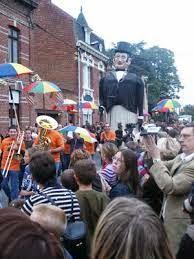
Les géants – giant puppets - The giant puppets we see during the Carnival of Arras are another
intriguing feature of the Belvaux film and one that reflects the cultural gap
between the two main characters. The puppets,
a very popular part of many festivities in the north of France, are so big that
the puppeteers have to go completely inside the puppet. They can be as tall as
eight meters and are constructed on a basket frame made of wicker. Their
presence at carnivals and festivities in Flemish towns on both sides of the
French-Belgian border dates back to the sixteenth century and the giant puppets
may have their origin in Spain or Portugal – at that time the Spanish crown
held territory throughout the area. Originally,
the géants were Saints and protagonists from the Bible carried through the
streets on local saint’s days, but in the years since the French Revolution they
have assumed a secular and popular identity.
Colas and Jaqueline, Arras' giants, are dressed as artisanal peasants and have been around since the carnival of 1891. In 1995, they gave birth to their son Dédé. They come out in late August for the festivities celebrating the end of the Spanish occupation (1659) and they can sometimes be seen at Bastille Day. However, their major sortie is during the Fêtes d’Arras at Carnival time – after all that is their anniversary.
We have seen the giants before at the Sacramento French Film Festival. Our opening film of 2005 SFFF – Quand la mer monte (2004) (When the Sea Rises) starring Yolande Moreau and Will Waert and filmed on location featuring the giant Totor a puppet from Steenwerck.
Karaoke - The role of the karaoke in Pas son genre is another aspect of the film that may pique our
curiosity as it articulates the cultural distance between Clément and Jennifer.
Its not a feature of any French films that I can think of, but it has been used
in a number of American movies. Marlow
Stern, an entertainment editor at The
Daily Beast, has compiled a list of greatest movie karaoke scenes. From the list, I think my favorite for its
beauty and depth of meaning is Bill Murray in Lost in Translation.


